


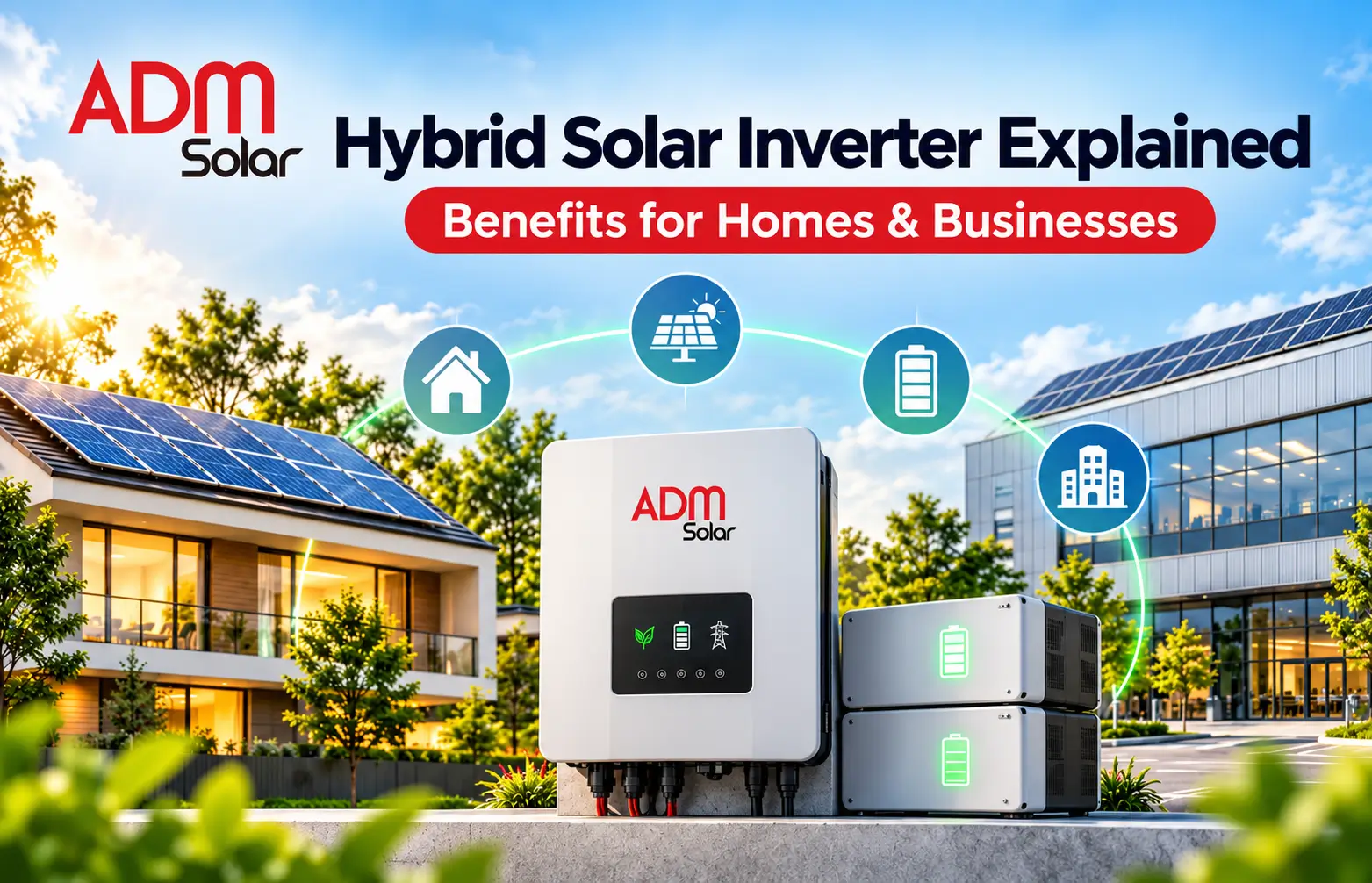
India’s growing demand for reliable and sustainable electricity has increased interest in solar energy solutions for homes, institutions, commercial spaces, and industrial facilities. A hybrid solar inverter is an important component of a solar power system because it manages electricity generated by solar panels, energy stored in batteries, and power supplied by the grid. For users looking to improve energy management and maintain backup power during outages, a hybrid solar inverter can be a practical solution.
ADM Solar offers a range of solar inverter solutions, including on-grid, off-grid, and hybrid solar inverters, tested in accordance with global testing standards. By understanding how hybrid inverters work, their benefits, and how to select the right capacity, homeowners and businesses can make more informed decisions about their solar energy investments.
What Is a Hybrid Solar Inverter?
A hybrid solar inverter converts direct current (DC) electricity generated by solar panels into alternating current (AC) electricity used by most household and business appliances. Unlike a conventional grid-connected inverter, a hybrid solar inverter can also manage battery storage and coordinate power from solar panels, batteries, and the grid.
This allows users to use solar electricity when it is available, store surplus energy in compatible batteries, and draw electricity from the grid when necessary. When the system is appropriately designed, a hybrid inverter can also provide backup power during a grid outage.
For homes and businesses seeking greater control over electricity consumption, a solar hybrid inverter offers a flexible approach to managing solar generation, battery charging, and energy usage.
How Does a Hybrid Solar Inverter Work?
A hybrid solar inverter acts as the heart of a modern solar system, coordinating three main energy sources:
- Solar panels: Generate electricity from sunlight to power connected appliances and support battery charging.
- Battery storage: Stores energy for use when solar generation is insufficient or during grid outages.
- Electricity grid: Supplies additional electricity when solar and battery power cannot meet demand.
During sunny hours, solar panels can supply electricity to connected loads. Surplus generation may charge the battery, subject to the inverter’s settings and battery compatibility. When solar generation decreases, the system can switch to stored battery energy or draw electricity from the grid.
The exact operating sequence depends on the inverter model, battery configuration, settings, and installation design. Backup operation also requires correctly configured backup circuits.
Key Benefits of a Hybrid Solar Inverter for Homes and Businesses
Reliable Backup Power
One of the main advantages of a hybrid solar inverter is its ability to provide backup power when the grid supply fails. With a compatible battery and a properly designed backup circuit, essential appliances, lighting, computers, and selected equipment can continue operating during an outage.
For homes, this improves convenience during power interruptions. For institutions and commercial spaces, backup power can help maintain selected operations. Actual backup duration depends on battery capacity, connected loads, and energy consumption.
Better Solar Energy Utilization
A hybrid solar inverter helps users make greater use of the electricity generated by their solar panels. Instead of relying entirely on immediate solar production, compatible systems can store surplus energy in batteries for later use.
This is useful for households with evening electricity demand and for businesses that need power outside peak sunlight hours. Effective energy utilization depends on system design, battery capacity, consumption patterns, and available sunlight.
Smart Energy Management
Hybrid inverters coordinate solar generation, battery charging, and grid electricity according to their operating modes and settings. ADM ARC Series hybrid inverters offer smart grid connectivity and a power export limit feature, giving users more control over how available energy is used.
Remote monitoring and Wi-Fi/GPRS/LAN communication options help users and system operators review system performance, subject to model specifications.
Potential Electricity Bill Savings
A hybrid solar inverter can help reduce electricity purchased from the grid by prioritizing available solar power and stored energy. However, actual savings depend on electricity tariffs, daytime consumption, battery costs, system sizing, and applicable grid-export or net-metering rules.
A hybrid system should be evaluated against the user’s energy requirements and expected financial returns rather than assuming a fixed percentage of savings.
Flexible, Future-Ready Configuration
Hybrid solar inverters offer flexibility when designing solar systems for different applications. Depending on the model, users may have options for battery integration, operating modes, and backup loads. Users can also add batteries later, provided the inverter and installation are compatible.
This makes hybrid technology worth considering for residential rooftops, educational and institutional buildings, petrol pumps, cold storages, and other commercial applications.
Hybrid Solar Inverter 3kW vs 5kW: Which Capacity Should You Choose?
Choosing the right hybrid solar inverter depends on your electricity consumption, connected appliances, and backup power requirements. A 3kW-class system may suit smaller homes with moderate energy needs, while a 5kW-class system may be a better option for larger households or small businesses with higher demand.
Before selecting an inverter, consider the total load of your appliances, the starting power required by motors and air conditioners, solar panel compatibility, battery capacity, and the expected backup duration. Comparing these factors will help you choose a system that meets your needs without paying for unnecessary capacity.
ADM Solar’s ARC Series single-phase hybrid inverters are available from 3.2 kVA to 10.2 kVA. Inverter capacity is quoted in kVA, while usable power is rated in kW, so check each model’s datasheet for its kW rating before comparing a 3kW-class and a 5kW-class system.
Hybrid Solar Inverter vs. On-Grid and Off-Grid Inverters
Understanding the differences between inverter types can help you select the right solution.
On-grid solar inverters work with the electricity grid and let you reduce electricity bills through net metering, where applicable. ADM ATOM Series single-phase on-grid inverters are available from 1 kW to 6 kW, with up to 98% efficiency. They offer simple system design and low maintenance, which suits many urban homes. Standard on-grid systems shut down during grid outages for safety, using anti-islanding protection, unless a suitable backup arrangement is provided.
Off-grid solar inverters are designed for systems that operate independently of the grid, usually with battery storage. They are useful where grid electricity is unavailable or unreliable.
Hybrid solar inverters combine grid-connected operation with battery management. They use solar, battery, and grid power to meet energy requirements and provide backup during outages. A hybrid system is typically the better fit where power cuts are frequent or backup is a priority.
The right choice depends on grid availability, backup requirements, installation budget, and energy consumption patterns.
Why Choose ADM Solar for Solar Inverter Solutions?
ADM Solar provides solar inverter solutions for residential, commercial, and institutional requirements. Its portfolio includes ATOM Series on-grid inverters, ARC Series hybrid inverters, Helios Series MPPT-based solutions, and KIAN Series PWM inverters.
The ADM ARC Series hybrid inverter is designed to manage power from solar panels, batteries, and the grid. Listed features include:
- Wide input voltage range
- Overvoltage protection
- Smart grid connectivity and power export limit
- Remote monitoring with Wi-Fi/GPRS/LAN communication
- Large LCD display and compact design
ADM Solar highlights BIS-certified inverters with anti-islanding protection, and its inverters are lightweight and easy to handle. Certification and features vary by product, so check the datasheet for the specific model you are considering.
For buyers comparing solar inverter manufacturers in India, reviewing product specifications, certifications, protection features, monitoring capabilities, compatibility, and after-sales support is important before making a purchase decision.
Explore ADM Solar’s solar inverter range to learn more about available inverter technologies and identify a suitable solution for your project.
Conclusion
A hybrid solar inverter can help homes and businesses manage solar electricity, battery storage, and grid power through one integrated system. Its potential benefits include backup power, improved use of solar energy, smart energy management, and possible electricity bill savings.
Whether you are researching a hybrid solar inverter for your home or comparing a 3kW-class and 5kW-class solution for a business, evaluate your energy consumption, battery requirements, and technical specifications before choosing a system.
ADM Solar offers multiple inverter technologies to address different energy needs. By reviewing the available models and selecting a system that matches your requirements, you can take a more informed step towards reliable and sustainable solar power.