


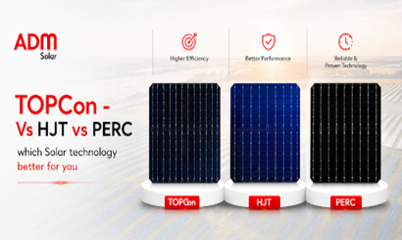
Understanding Mono PERC, TOPCon, and HJT Solar Panels
Thinking about installing solar panels on your house but feeling confused by terms like Mono PERC solar panel, TOPCon solar panel, or HJT solar panels? Many people face the same issue. These technical words can sound complicated, but once you understand the three main types, the rest becomes clearer. These are basically variations built on similar foundations but with different strengths.
Choosing solar power is a practical decision that supports sustainable living and helps reduce electricity costs over time. In this article, we explain Mono PERC Solar Panels, TOPCon Solar Panels, and HJT Solar Panels in plain, everyday language. We cover how they work, their main differences, detailed pros and cons, and which might suit different situations. This will help you find the best solar panel for your needs.
What Are Mono PERC Solar Panels?
Mono PERC Solar Panels are among the most widely used options. PERC means Passivated Emitter and Rear Cell. These panels start with standard crystalline solar cells and add a special passivation layer on the back. This layer reflects sunlight that passes through the cell back into it, giving a second chance to generate electricity.
This design improves performance compared to older panels. Half-cut versions with more cells split in half are also common. They help reduce power losses and perform better when some parts are shaded.
What Are TOPCon Solar Panels?
TOPCon Solar Panels take the PERC idea further. TOPCon stands for Tunnel Oxide Passivated Contact. They include an extra thin tunnel oxide layer and a doped poly-silicon layer on the back. This reduces energy losses more effectively and reflects more light back to the cells.
As a result, TOPCon Solar Panels deliver higher power output. They also handle high temperatures better, which is useful in hot climates. Bifacial versions that capture light on both sides are popular for open areas where reflected light is available.
What Are HJT Solar Panels?
HJT Solar Panels represent advanced technology. HJT means Heterojunction Technology. These panels combine crystalline silicon with thin layers of amorphous silicon on both sides, finished with Indium Tin Oxide coatings. This structure captures more sunlight from different angles and reduces energy waste.
HJT Solar Panels perform well in low light and high temperatures. They often reach the highest efficiency levels. Bifacial and half-cut options are available here too.
Pros and Cons of Each Type of Solar Technology
Here is a clear description of the real-world pros and cons based on how these panels actually perform:
Mono PERC Solar Panels
Pros
They are affordable and easy to find everywhere. You get decent efficiency without spending too much. They have a proven long track record, work reliably in normal conditions, and need less space than older panels to produce the same power. This makes them practical for regular homes.
Cons:
Their efficiency is lower than the newer types, so you may need more panels for the same output. They lose more power in very high heat, and overall energy production is not as high in tough conditions compared to TOPCon or HJT.
TOPCon Solar Panels
Pros
They offer noticeably better efficiency, which means more electricity from the same roof area. They handle heat well with less drop in performance, have lower yearly degradation so they stay stronger for longer, and their bifacial versions capture extra light from the back. Manufacturing is not too different from older methods, so the price increase is reasonable. Many people find them a good middle option.
Cons
They cost a bit more than Mono PERC. In some regions, supply is still growing, and the extra layers make production slightly more complex.
HJT Solar Panels
Pros
These give the highest efficiency, often above 25%, so they produce the most power per square meter. They perform excellently in low light (cloudy days) and high temperatures, have the slowest degradation rate, and last longer overall. Their bifacial ability is very strong, making them great for maximum energy harvest.
Cons
They are the most expensive due to new manufacturing equipment and materials. Being a newer technology, there are fewer suppliers, and they can be more sensitive to moisture during installation and handling. Some people worry about long-term field data since they have not been around as long as the others.
Key Differences Between Mono PERC, TOPCon, and HJT Solar Panels
All three types turn sunlight into electricity but differ in design, production, and results
Feature |
Mono PERC Solar Panels |
TOPCon Solar Panels |
HJT Solar Panels |
Production Process |
8-step process |
Similar 10-step process on much of the same equipment |
Different 4-5 step process with specialized machinery |
Efficiency |
19-22% |
22-24% |
Over 25% |
Lifespan |
Usually 25-30 years |
Usually 25-30 years |
30+ years |
Degradation |
Standard yearly loss |
Standard yearly loss |
Slower yearly loss |
Temperature Performance |
Higher efficiency loss in hot weather |
Loses less efficiency in hot weather |
Loses less efficiency in hot weather |
Cost |
Cheapest |
Small premium over Mono PERC |
Costs the most |
Bifacial PV Modules |
Available |
Available |
Available |
Applications In Government Subsidy Schemes
For PM Surya Ghar residential rooftops (1–3 kW systems), Mono PERC Solar Panels often work well due to their balance of cost and performance on smaller roofs. TOPCon Solar Panels are a good step up for higher output.
In PM Kusum Component A ground-mounted plants (500 kW–2 MW), TOPCon Solar Panels provide strong results where space optimization and long-term yield matter. Bifacial versions perform especially well in open fields.
For PM Kusum Component B agricultural pumps, Mono PERC Solar Panels remain practical due to cost considerations in standalone systems.
HJT Solar Panels suit projects needing maximum efficiency in limited space or challenging conditions.
Final Thoughts
Mono PERC, TOPCon, and HJT Solar Panels each have their place. Mono PERC offers solid, cost-effective performance for standard needs. TOPCon provides better efficiency and durability at a reasonable extra cost. HJT delivers top performance for those who prioritize maximum output and longevity.
The best solar panel depends on your roof size, budget, local climate, and energy requirements. Consider factors like available sunlight, installation space, and long-term savings when deciding. Government schemes such as PM Surya Ghar and PM Kusum can support your project, so check current guidelines for approved options.
Understanding these differences, including the detailed pros and cons, helps you make a practical choice for your solar installation. Whether you go with Mono PERC, TOPCon, or HJT PV modules, solar power brings steady benefits in reduced bills and cleaner energy. Take time to compare real quotes and match the technology to your situation for the best results.
Stay Connected Stay Updated