


Solar energy is transforming how homes, businesses, and industries generate electricity in India. With rising electricity demand, government initiatives, and advancements in photovoltaic technology, solar power has become an increasingly practical solution for reducing electricity expenses and supporting sustainable development.
However, choosing the right solar system is essential for achieving efficient electricity generation and reliable performance.
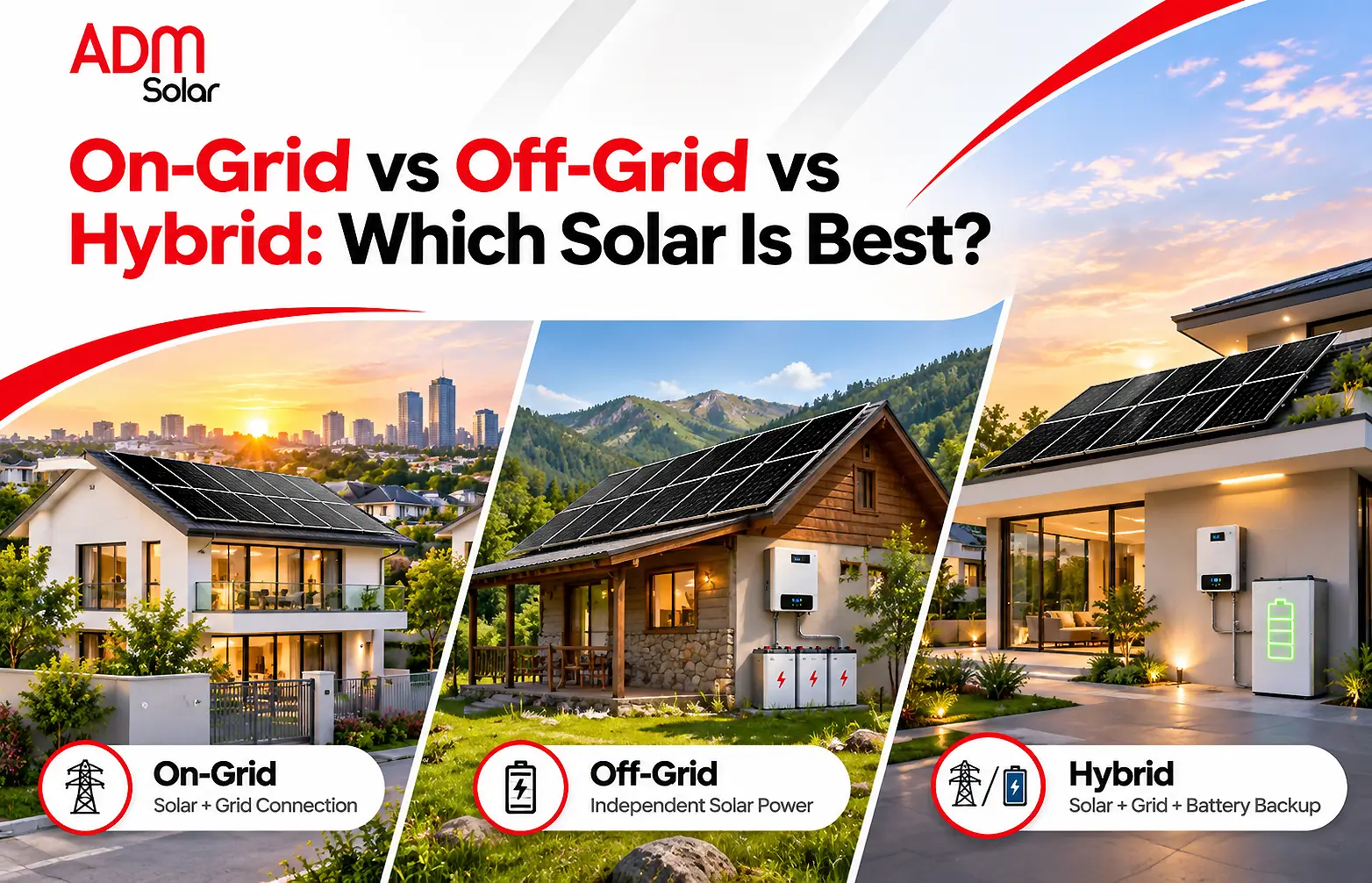
On-Grid, Off-Grid, and Hybrid Solar Systems operate differently based on grid connectivity, inverter technology, and battery storage requirements. Understanding these differences helps homeowners and businesses select the most suitable system.
This guide explains how each solar system works, its advantages, technical components, and important considerations before installation.
Understanding the Three Types of Solar Systems
Solar photovoltaic (PV) systems convert sunlight into electricity using semiconductor-based solar cells. The electricity generated is direct current (DC), which a solar inverter converts into alternating current (AC) for electrical appliances.
Depending on how electricity is managed, solar installations are classified into three categories:
- On-Grid Solar Systems: Connected to the utility electricity grid without conventional battery backup.
- Off-Grid Solar Systems: Operate independently of the utility grid using solar panels and battery storage.
- Hybrid Solar Systems: Combine grid connectivity with battery storage for flexible electricity management.
The appropriate configuration depends on electricity consumption, grid availability, installation location, and backup requirements.
What Is an On-Grid Solar System?
An on-grid solar system, also known as a grid-tied solar system, operates in synchronization with the utility electricity network.
Solar PV modules generate DC electricity, which an on-grid inverter converts into AC electricity for immediate consumption. When solar generation is insufficient, additional electricity is drawn from the grid.
If solar generation exceeds consumption, surplus electricity can be exported to the grid where regulations permit. Net metering or other approved billing arrangements determine how exported electricity is credited.
ADM Solar's ATOM Series Single-Phase On-Grid Solar Inverters are designed for efficient power conversion and grid integration. The series offers up to 98% efficiency, supporting residential and compatible commercial solar installations.
Benefits of On-Grid Solar Systems
- Reduced Electricity Bills: Solar generation offsets electricity purchased from the utility grid, reducing monthly energy expenses.
- Lower Initial Investment: Since conventional on-grid installations do not require batteries, their upfront investment is generally lower.
- Efficient Power Conversion: Advanced inverter technology optimizes the conversion of solar-generated DC electricity into usable AC power.
- Low Maintenance: Fewer components and the absence of battery storage simplify routine maintenance.
- Scalable Applications: On-grid installations are suitable for residential rooftops, offices, commercial buildings, and industrial facilities.
However, standard on-grid systems automatically disconnect during utility outages through anti-islanding protection. Therefore, they cannot provide backup electricity without additional compatible equipment.
What Is an Off-Grid Solar System?
An off-grid solar system generates and manages electricity independently of the utility grid. It is suitable for agricultural farms, remote villages, isolated buildings, and locations with limited electricity infrastructure.
These systems generally consist of solar PV modules, a solar inverter, a charge controller, and battery storage.
During daylight hours, solar panels generate electricity for connected appliances while charging the battery bank. Stored energy supplies electricity at night or when sunlight is insufficient.
ADM Solar offers the Helios Series Smart MPPT Inverter, designed for optimized solar energy harvesting and battery integration. Its KIAN Series Smart PWM Inverter provides an alternative for suitable everyday solar power applications.
Benefits of Off-Grid Solar Systems
- Independent Electricity Supply: Off-grid systems generate electricity without depending on a utility connection.
- Battery Backup: Stored solar energy supports electricity consumption when direct solar generation is unavailable.
- Suitable for Remote Areas: Off-grid systems support agricultural installations, rural properties, and locations without dependable grid access.
- Flexible Storage Capacity: Battery storage can be configured according to electricity consumption and expected backup duration.
- Reduced Generator Dependence: Properly designed solar installations can reduce reliance on conventional fuel-powered electricity generation.
However, off-grid systems require careful sizing because their performance depends on available sunlight, battery capacity, and connected electrical loads.
What Is a Hybrid Solar System?
A Hybrid Solar System combines solar electricity generation, utility grid connectivity, and battery storage within one integrated power management configuration.
Hybrid solar inverters manage electricity from solar panels, batteries, and the utility grid according to consumption requirements and system settings.
During the daytime, solar energy powers connected appliances, while surplus generation can charge batteries. When solar production decreases, stored electricity or grid power supports consumption.
During utility outages, properly configured hybrid systems can supply designated backup loads using available solar generation and battery energy.
ADM Solar's ARC Series Single-Phase Hybrid Solar Inverters, available in capacities from 3.2 kVA to 10.2 kVA, offer intelligent power management, smart grid connectivity, remote monitoring, and battery integration.
Benefits of Hybrid Solar Systems
- Reliable Backup Power: Battery storage supports essential electrical loads during power interruptions.
- Smart Energy Management: Hybrid inverters coordinate electricity distribution between solar generation, batteries, and the grid.
- Improved Solar Utilization: Excess daytime electricity can be stored for use during evening hours.
- Reduced Grid Dependence: Battery storage helps consumers use more self-generated solar electricity.
- Flexible Applications: Hybrid systems are suitable for homes, offices, institutions, and businesses requiring backup power.
Although hybrid systems generally involve higher initial investment, they provide additional operational flexibility and energy security.
On-Grid vs Off-Grid vs Hybrid Solar Systems: Key Differences
The following comparison highlights the major differences between these solar configurations.
Features |
On-Grid |
Off-Grid |
Hybrid |
|---|---|---|---|
Grid Connection |
Required |
Not required |
Yes |
Battery Storage |
Not required |
Generally required |
Required for backup |
Backup During Outages |
No |
Yes |
Yes |
Initial Investment |
Lower |
Higher |
Generally higher |
Net Metering |
Where permitted |
No |
Where supported |
Energy Independence |
Partial |
Grid-independent |
Greater flexibility |
Maintenance |
Low |
Moderate |
Moderate |
Suitable For |
Urban properties |
Remote locations |
Backup-dependent users |
Which Solar System Is More Cost-Effective?
On-grid solar systems generally offer a lower initial investment because batteries are unnecessary. They are suitable for consumers primarily interested in reducing electricity bills.
Off-grid systems require battery storage and additional equipment, increasing installation expenses. However, they provide essential electricity access where utility infrastructure is unavailable.
Hybrid systems involve additional storage investment but provide greater flexibility during power outages. Their financial suitability depends on electricity consumption, battery costs, grid reliability, and energy tariffs.
Important Factors Before Choosing a Solar System
Solar Panel Technology and Efficiency
Solar panel efficiency directly influences electricity generation and installation space requirements.
ADM Solar's X-Press Series uses Mono PERC half-cut cell technology, while its X-Nova Series features N-Type TOPCon bifacial modules.
N-Type TOPCon technology offers high energy conversion efficiency, improved temperature performance, and reduced degradation. Bifacial modules can additionally generate electricity from sunlight reflected onto their rear surface, depending on installation conditions.
Inverter Technology
Selecting a compatible inverter is essential for efficient electricity conversion.
On-grid inverters synchronize with utility electricity, off-grid inverters support independent power generation, and hybrid inverters coordinate grid power with battery storage.
Maximum Power Point Tracking (MPPT) helps optimize energy extraction from solar panels under varying sunlight conditions.
Battery Storage Requirements
Battery capacity should match daily electricity consumption and expected backup duration.
ADM Solar's Apollo Series lithium-ion batteries and S-Series tubular batteries provide storage options for compatible solar applications.
Battery selection should consider usable capacity, charging requirements, operating conditions, and inverter compatibility.
Why Choose ADM Solar for Solar Power Solutions?
ADM Solar is an Indian solar energy manufacturer offering advanced photovoltaic modules, solar inverters, and battery storage solutions for residential, commercial, and industrial applications.
According to its updated official website, ADM Solar has 2.2 GW PV module manufacturing capacity, supported by advanced manufacturing infrastructure and quality-focused production processes.
Its product portfolio includes X-Press Mono PERC modules, X-Nova N-Type TOPCon bifacial modules, ATOM on-grid inverters, ARC hybrid inverters, Helios MPPT inverters, KIAN PWM inverters, and energy storage solutions.
ADM Solar emphasizes automated manufacturing, stringent quality inspections, and electroluminescence (EL) testing. Its catalogue also identifies BIS and IEC standards applicable to its solar PV modules.
These technologies support dependable solar energy generation across different installation requirements.
Conclusion
Choosing between On-Grid, Off-Grid, and Hybrid Solar Systems depends on electricity consumption, grid reliability, budget, and backup requirements.
On-grid systems are suitable for reducing electricity expenses where utility supply is reliable. Off-grid systems provide independent power generation for remote locations, while hybrid systems combine solar generation, battery storage, and grid connectivity.
Investing in efficient photovoltaic modules, compatible inverters, and appropriate energy storage is essential for long-term performance.
With advanced Mono PERC and N-Type TOPCon solar panels, intelligent inverter technologies, and battery solutions, ADM Solar offers a diversified product portfolio to support India's transition towards reliable and sustainable solar energy.