


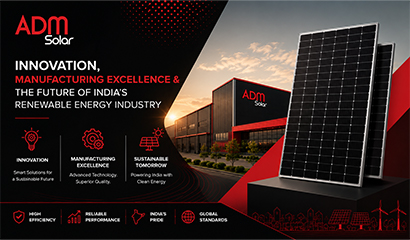
India’s renewable energy sector is undergoing a major transformation as solar power adoption continues to accelerate across residential, commercial, industrial, and utility-scale applications. Rising electricity demand, government initiatives, increasing environmental awareness, and rapid advancements in solar technology are encouraging businesses and consumers to invest in sustainable energy solutions.
As the solar industry evolves, manufacturers are focusing not only on increasing production capacity but also on improving technology, efficiency, durability, and long-term system performance. Advanced photovoltaic technologies such as TOPCon and Mono PERC solar panels are becoming increasingly important in meeting the growing need for efficient and reliable energy generation.
ADM Solar continues to contribute to this evolving renewable energy landscape through advanced solar technologies, manufacturing expansion, quality-focused production standards, and participation in India’s rapidly growing clean energy ecosystem.
India’s Rapid Growth in Renewable Energy
India has emerged as one of the fastest-growing renewable energy markets in the world. Over the past few years, the country has significantly increased investments in:
- rooftop solar systems
- industrial solar projects
- utility-scale solar farms
- domestic solar manufacturing
- renewable energy infrastructure
The government’s push toward renewable energy adoption and domestic manufacturing has encouraged solar companies to invest in modern production technologies and large-scale manufacturing capabilities.
At the same time, consumers are becoming more aware of the long-term financial and environmental benefits of solar energy. Businesses are also adopting renewable energy solutions to reduce operational costs, improve sustainability, and achieve long-term energy independence.
This rapid industry growth has created strong demand for advanced solar modules that can provide:
- higher efficiency
- lower degradation
- improved durability
- better low-light performance
- long-term operational reliability
ADM Solar’s Focus on Manufacturing Expansion
As demand for solar energy continues to increase, manufacturing capacity has become a critical part of the renewable energy ecosystem. Solar companies are now investing heavily in expanding production infrastructure to support future energy requirements and strengthen domestic supply chains.
ADM Solar’s manufacturing expansion plans reflect this broader industry trend toward scalability, technological advancement, and self-reliance in renewable energy production.
Increasing manufacturing capacity offers several long-term advantages:
- improved product availability
- reduced dependence on imports
- better supply chain stability
- faster project execution
- support for India’s renewable energy goals
Modern manufacturing infrastructure also allows solar companies to adopt advanced automation and precision-driven production methods, helping improve product consistency and quality standards.
As India moves toward higher renewable energy targets, manufacturing growth will continue to play a major role in supporting large-scale solar adoption across different sectors.
Importance of D-U-N-S Certification & Global Recognition
In today’s global business environment, credibility and compliance standards are becoming increasingly important, especially within the renewable energy industry.
ADM Solar’s D-U-N-S certification represents a significant milestone in strengthening business credibility and supporting future global growth opportunities.
D-U-N-S registration is widely recognized internationally and is often associated with:
- business verification
- supply chain transparency
- international trade credibility
- global corporate identification
- enhanced business trust
For renewable energy companies, certifications and compliance standards help improve confidence among:
- business partners
- customers
- suppliers
- financial institutions
- international markets
As the solar industry becomes more interconnected globally, recognized certifications continue to play an important role in supporting long-term business growth and industry positioning.
Advanced Solar Technologies: TOPCon & Mono PERC Panels
The solar industry is evolving rapidly, with modern photovoltaic technologies delivering better efficiency and improved long-term energy generation compared to earlier generations of solar modules.
ADM Solar focuses on advanced solar technologies such as TOPCon and Mono PERC panels, which are becoming increasingly popular in residential, commercial, and industrial applications.
These technologies are designed to address common solar performance challenges while maximizing energy output and system reliability.
Understanding TOPCon Solar Technology
TOPCon (Tunnel Oxide Passivated Contact) technology is considered one of the most advanced innovations in modern solar manufacturing.
Traditional solar cells experience small energy losses due to electron recombination during electricity generation. TOPCon technology improves cell architecture by introducing additional passivation layers that reduce these losses and increase overall efficiency.
This advanced design allows TOPCon panels to deliver:
- higher energy conversion efficiency
- improved low-light performance
- lower degradation rates
- better temperature handling
- enhanced long-term output
One of the major advantages of TOPCon panels is their ability to maintain strong performance in high-temperature environments, making them suitable for regions with intense sunlight and warm climates.
Because of these benefits, TOPCon technology is increasingly becoming a preferred solution for projects seeking maximum long-term energy generation and efficiency.
Why Mono PERC Panels Continue to Be Popular
Mono PERC (Passivated Emitter and Rear Contact) panels remain one of the most widely used solar technologies due to their balance between affordability and performance.
Mono PERC technology improves upon conventional monocrystalline panels by adding a passivation layer at the rear side of the solar cell. This helps improve light absorption and energy conversion.
Mono PERC panels offer several advantages:
- improved efficiency compared to traditional panels
- better low-light performance
- reliable long-term operation
- efficient rooftop space utilization
- cost-effective installation options
Because of their affordability and reliable performance, Mono PERC panels continue to be widely used across:
- residential rooftops
- commercial buildings
- educational institutions
- industrial facilities
Solar Panel Manufacturing Process
The quality of a solar panel depends heavily on the manufacturing process. Modern solar panel production involves highly controlled and precision-driven stages to ensure product reliability and long-term durability.
The manufacturing process typically begins with photovoltaic cell preparation, where solar cells are engineered to optimize electrical performance and energy conversion.
These cells are then interconnected through automated stringing processes that create electrical pathways for energy generation. After interconnection, the modules undergo lamination, where protective encapsulation layers are added to improve weather resistance and structural durability.
Additional stages include:
- frame assembly
- glass integration
- junction box installation
- electrical testing
- thermal inspection
- quality verification
Each stage plays an important role in ensuring the final solar module can withstand challenging environmental conditions while maintaining efficient long-term performance.
Modern manufacturing facilities increasingly use automation and advanced quality-control systems to improve consistency, reduce defects, and enhance production efficiency.
Importance of Quality & Reliability in Solar Manufacturing
Solar systems are long-term investments expected to operate for 20–25 years or more. Because of this, manufacturing quality directly impacts:
- system lifespan
- energy generation
- weather resistance
- operational safety
- maintenance requirements
Poor-quality solar modules may experience:
- faster degradation
- reduced energy output
- performance instability
- environmental damage
High-quality manufacturing standards help ensure panels can withstand:
- extreme temperatures
- humidity
- heavy rainfall
- wind loads
- UV exposure
Reliable manufacturing processes are particularly important for commercial and industrial projects where energy performance and operational continuity are critical.
Participation in Renewable Energy Industry Events
Renewable energy exhibitions and industry events continue to play an important role in the development of the solar sector.
Participation in industry expos provides opportunities to:
- showcase advanced technologies
- strengthen business relationships
- understand emerging market trends
- promote innovation
- encourage collaboration within the renewable energy ecosystem
These events also help companies stay updated with advancements in:
- photovoltaic technologies
- energy storage systems
- smart monitoring platforms
- hybrid energy solutions
As the renewable energy market continues to expand, industry collaboration and knowledge sharing will remain important drivers of technological progress.
Future of Solar Manufacturing & Technology
The future of solar manufacturing is expected to focus on:
- higher module efficiency
- smarter energy systems
- scalable production infrastructure
- advanced battery integration
- AI-driven monitoring technologies
- sustainable manufacturing practices
Technologies such as:
- TOPCon
- bifacial solar panels
- smart hybrid systems
- advanced energy storage
As energy demands continue to increase globally, solar manufacturing innovation will remain essential for improving sustainability, affordability, and long-term energy security.
Final Thoughts
India’s solar industry is entering a new era of innovation, manufacturing expansion, and renewable energy adoption. Advanced photovoltaic technologies, scalable production infrastructure, and high-quality manufacturing standards are becoming increasingly important in supporting the country’s transition toward sustainable energy solutions.
As solar adoption continues to grow across residential, commercial, and industrial sectors, long-term reliability, efficiency, and technological advancement will remain key priorities for the renewable energy industry.
ADM Solar continues to support this transition through advanced solar technologies, modern manufacturing capabilities, and reliable renewable energy solutions designed to meet the evolving energy requirements of homes, businesses and industries.